



First responders of the Bluebonnet region





Recent news
Story by Clayton Stromberger
With a patient skritch skritch skritch skritch, Sandra Matthijetz slowly moves the tip of a small retractable knife over the shiny surface of an emerald-colored chicken egg. She scrapes off narrow layers of dye, creating concentric oval patterns where the white shell of the egg peeks through.
“You just keep working at it,” Matthijetz says of her freehand creation. A dyed chicken egg is a small canvas with no eraser, which means she has to cheerfully incorporate any slips of the scratching tool. “Sometimes you start a design and something goes haywire, so then you have to come up with a new design.” She laughs and gently continues scraping, steadying the egg in her left hand.
Matthijetz, 74, is fashioning a unique Easter egg at the Texas Wendish Heritage Museum in Serbin. She is carrying on a rich tradition that her Wendish ancestors brought with them to southern Lee County in Central Texas more than a century and a half ago. The Wends, or Sorbs as they are known in Central Europe, are a Slavic people who for centuries have lived near the area where the current borders of eastern Germany, Poland and the Czech Republic meet. They have never had their own country, but speak their own language – Wendish, or Sorbian. In the fall of 1854, nearly 600 Wends who sought religious and cultural freedom from what they viewed as repressive measures of the Prussian government left their homes in the Lusatia region of Europe to relocate in Texas. They followed the trail of a small group of Wendish immigrants who arrived in Texas the previous year. This hardy Lutheran congregation eventually formed the community of Serbin — or “Sorbian land” in Wendish — about 6 miles southwest of Giddings.
Eggs are a symbol of new life and renewal throughout the world, and archaeologists have found fragments of decorated ostrich eggs dating back at least 65,000 years. Crafting elaborately designed and colorful eggs for springtime is an ancient Slavic tradition, with slightly varied styles appearing in cultures throughout the region, from the Wends in eastern Germany to Russia. In Wendish culture, decorated eggs are created throughout the year in preparation for Easter, and play a key role in rites of spring, including children’s games and gift giving.
A basket of Wendish eggs can be as breathtaking as a Texas countryside meadow bursting with spring wildflowers — a dazzling array of bright reds, rich yellows, forest greens and indigo blues.
They feature intricate swirls, radiating lines, floral patterns and complex mosaic-like arrangements with multiple layers of dye coloring. No two eggs are alike and each can take hours to create.
Wendish eggs are a significant enough cultural tradition to be on permanent exhibit at the Institute of Texan Cultures, which is part of the University of Texas at San Antonio. The institute’s website includes a photo of a dozen decorated Easter eggs and a video featuring the “anthem of the Lusatian Sorbs,” sung in Sorbian. Go to bit.ly/3uSE7sL to see it.
If you’ve ever spent a spring day tinkering with dyeing Easter eggs, you may appreciate the four basic approaches the Wendish use in this folk art form. Two involve the application of color, and two involve the removal of color to reveal the eggshell.
For layering on color, wax batik is the most common technique. The egg is either “blown” — its contents carefully removed through small holes in each end — or hardboiled. Barnyard eggs are preferred because they are hardier than store-bought eggs.
Clear melted wax is applied in a pattern on the egg, often using the tip of a specially cut feather from a goose, duck or chicken. When dying the egg, colors are added from lightest to darkest. After each color dries, another wax design is added and the next color applied. After all designs and colors are applied, wax is melted over a candle and wiped away with a soft cloth to reveal an egg of multiple designs and colors.
Embossing, another technique for applying color, involves carefully painting the egg with colored wax, which can add a beautiful bead-like effect.
For removing color, the scratch technique involves sharp tools to scrape dye from an eggshell. The acid technique uses sauerkraut juice, vinegar — or, for experienced artisans, diluted muriatic acid — to paint away dye. The method produces a more watery-edged pattern.
Most Wendish decorators use chicken eggs or slightly larger goose eggs, because they’re easy to obtain and handle. In Germany, some Wendish egg artists seek a larger canvas and decorate 6-inch-long ostrich eggs. These prized creations can fetch top dollar each spring at the Easter markets in the Lusatia area of Germany.
Matthijetz was not steeped in Wendish tradition while growing up in the 1950s in Winchester, 10 miles south of Serbin. She was born nearly a century after her ancestors had set down new roots near Rabbs Creek in Fayette County, not far from Giddings. The Wendish language and cultural traditions were fading as the people spread out across Central Texas and assimilated.
The elders in Matthijetz’s family spoke German, so she thought of herself as a descendent of German immigrants. She recalls her grandfather’s brother reading unusual words aloud from a Wendish Bible, and her mother’s aunt creating beautifully decorated eggs at Easter.
“But those eggs were hard boiled, so they didn’t stick around. They got eaten,” she laughs.
Matthijetz left Winchester for big-city life in Houston after graduating from La Grange High School in 1965. She didn’t have many occasions to ponder the ways of the Wends until decades later.
“I didn’t really think of myself as Wendish until the Wendish Museum got started and I became interested in my heritage,” Matthijetz says.
The Texas Wendish Heritage Museum opened in Serbin in 1979. It grew out of the founding of the Wendish Culture Club in 1972 by a group of Lee County women eager to share their heritage at the Texas Folklife Festival in San Antonio. In 1989 the museum began hosting its annual Wendish Fest every fourth Sunday in September, an event that, in pre-pandemic days, would draw up to 2,000 people. The Fest was canceled in 2020 because of the COVID-19 pandemic, but returned in 2021 and is scheduled again for 2022.
As people of Wendish ancestry in Germany learned about the event, some began visiting Texas to see this unique Lone Star hub of their cultural heritage. One Wend, Kornelia Thor of Leipzig, visited in 2000 and then returned each fall throughout the decade to offer egg-decorating demonstrations at the festival. That sparked Matthijetz’s interest.
The two women became good friends, and Matthijetz and her husband Raymond — also from Winchester and a descendant of early Wend settlers — began visiting Thor in Germany. Together they toured the region’s traditional Easter markets, where countless decorated Wendish eggs are sold.
“In Germany, the Wendish people there grow up with this tradition,” Matthijetz says. “At the Easter markets, they have a room where the children are all decorating eggs. The young kids are able to use the hot wax and not get burned.”
Thor’s connection with the Texas Wendish Heritage Museum is still going strong. She decorates and mails about 200 decorated eggs each year to be sold in the gift shop. Chicken eggs are $25 and the larger goose eggs are $40. There are plenty available year-round. There are eggs with traditional patterns as well as some with a Texas twist, such as bluebonnets or an image of the Ben Nevis, the ship that carried the Serbin-area settlers from Liverpool to Galveston in 1854. You can also see Thor’s work on her German website, ostereierladen.com, which is German for “Easter egg shop.”
For those interested in trying out this Wendish tradition, the museum in Serbin sells a $31 egg-decorating kit with some basic tools and includes a copy of the small, self-printed book, “The Art of Decorating Wendish Easter Eggs,” by Daphne Dalton Garrett. Garrett, who was a longtime resident of Warda just southeast of Serbin, did much to revive Wendish cultural traditions in the area before she died in 2001. The museum also brings in Matthijetz for an egg-decorating workshop when enough people are interested; contact the museum for more information.
Matthijetz and her husband moved back to Winchester in 1998 after she retired from her career as an administrative assistant at a Houston manufacturing firm. To folks at the museum in Serbin, she is a local treasure — always ready to dress in a traditional Sorbian folk costume and share her passion for this unique living connection to another time and place.
“It’s important for the tradition of the eggs to continue so that we have a link back to our ancestors,” says Marian Wiederhold, an area resident of Wendish ancestry and longtime museum librarian and docent. She and Matthijetz are fourth cousins.
Matthijetz may be among the only practitioners of the folk art tradition of Easter egg decorating still living in the Serbin area. She is eager to do what she can to keep the storied tradition rolling on in this area where her ancestors first experienced a Texas springtime.
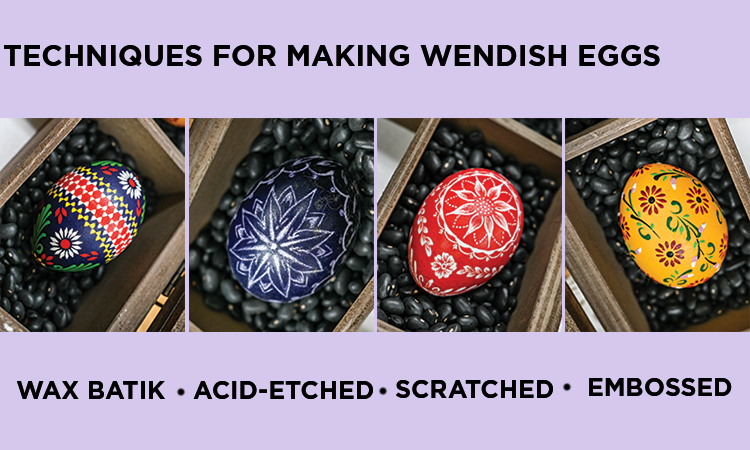
WAX BATIK
Texas Wends’ most common technique; delicate wax design applied to egg using trimmed tip of feather or head of straight pin (color doesn't adhere to waxed areas); wax dries and egg is dyed with lightest color; egg dries, second wax design applied and egg dyed again in slightly darker color; design continues until final darkest dye; wax melted with candle and wiped away.
ACID-ETCHED
Artist's pen with stainless steel fine point is filled with 50% muriatic acid/50% water; design drawn on dyed egg to expose white shell; in the past, sauerkraut juice or vinegar were used, but muriatic acid mix is preferred now; best technique for creating quick, clear designs.
SCRATCHED
Made by scratching away color from a dyed egg using a small, sharp instrument, such as a nail or thin tip of a knife; a slow process that carries risks because too much pressure by the decorator can puncture egg.
EMBOSSED
Similar to wax batik method except colored wax (pure beeswax is preferred) is painted onto an egg and is not removed after egg is dyed.
Learn to speak a little Wendish
The Wends are a Slavic people from East Germany near Bautzen and Cottbus in the upper Spree River valley, an area long known as Lusatia. They have their own language, Sorbian, which is divided into two dialects, Upper Sorbian and Lower Sorbian. The Wends never had an independent nation and were surrounded by Germans. Here are a few words, as taken from the book ‘‘A Practical Grammar of Upper Sorbian (Wendish)’’ by Charles Wukasch. The book is sold at the Wendish museum.
English: Good morning!
Sorbian: Dobre ranje!
Pronounced: DOE-beh RON-yay!
English: Good night
Sorbian: Dobry dżeń
Pronounced: DOE-bray zhen
English: Thank you!
Sorbian: Dźakuju so wam!
Pronounced: JOCK-you-you so wam!
English: Goodbye
Sorbian: Božemje
Pronounced: BOWSHIM-yay
English: Please!
Sorbian: Prošu!
Pronounced: PRO-zue!
By Alyssa Dussetschleger
After last February’s record winter storm, Central Texas residents have rushed to buy back-up generators in case their electricity is out for a prolonged period. However, generators can be dangerous, particularly portable ones that typically run on gasoline. A larger, permanently mounted standby generator, installed by a licensed, qualified electrician, can be a safer option, but they are backlogged by months at retailers, are more expensive and also pose some hazards. Although the National Oceanic and Atmospheric Administration predicts a warmer Texas winter in 2022, the Farmers’ Almanac says January could bring subfreezing temperatures. Whatever the winter of 2022 has in store for Central Texas, consumer interest in standby generators is likely to continue well beyond the season.
About standby generators
Although less-expensive portable generators are readily available, more costly and larger standby generators are getting attention from many Central Texas residents because they produce more power and are safer than portables.
These larger home generators must be permanently mounted outdoors by licensed, qualified professionals. Because they are in high demand in Texas, there are lengthy waitlists to buy and install these generators.
Home Depot and Lowe’s offer standby generators for $2,500 to $6,500, based on size requirements. Consultation and installation costs range from $3,000 to $6,500.
Among the most popular manufacturers of standby generators are Generac, Champion, Briggs & Stratton and Honeywell. The most popular brand sold by Zaskoda Repair in the city of Caldwell is Generac’s Guardian 24,000-watt generator. “These are typical for 2,000- to 2,200-square-foot homes,” said Zaskoda Repair’s owner, Tim Zaskoda. At his store, a generator, materials and installation range from $12,000 to $14,000. You can get an assessment appointment within two weeks from Zaskoda, but demand has led to months-long delays of generator delivery and installation.
In the Brenham area of Washington County, Zenith Power Systems sells and installs generators, but they have a waitlist of about six months for generators to arrive and be installed. The waitlist is shorter (about three months) for the company to send a factory-trained technician to survey your property and help you select a generator.
When connecting a standby generator, a certified generator installer or licensed electrician must temporarily have Bluebonnet disconnect your electric power to safely connect the generator to a transfer switch and your meter.
Bluebonnet members can speak to a member service representative by calling 800-842-7708 from 8 a.m. to 5 p.m., Monday through Friday, to schedule a line worker to temporarily disconnect power to the members’ home or business while a generator is installed and reconnect power when the job is done. Line workers also inspect the connection from the generator to the meter to ensure it meets safety requirements.
Standby generators require annual maintenance, and many installers offer annual maintenance packages for a few hundred dollars.
Kenny Lehmann, a Bluebonnet maintenance specialist in Giddings, installed a standby generator at his home in October 2020. He tests it weekly, using an app on his smartphone to turn it on. The app lets him manually operate the generator, see when it is running and how much power it is supplying.
Standby generators can still be dangerous. Overloading the generator by using more power than the machine is rated for can damage it and anything connected to it. However, when properly installed and safety measures followed, standby generators are far less dangerous than their smaller, portable counterparts.
The ABCs of generators
There are three basic types of generators, which vary in size, price, power source and safety:
Standby
Standby (whole house) generators are the most powerful and safest for home use. They range in power from 5,000 to 50,000 watts, and can cost nearly $2,000 up to $20,000. They run on natural gas or liquid propane and must be installed by a licensed, qualified electrician. A typical home requires, at minimum, a 5,000-watt generator to power its electric essentials. Right now, large permanently pad-mounted standby generators are backlogged several months at major home improvement stores, and for as long as a year for some area retailers that sell the popular Generac brand.
Portable

Portable generators typically run on gasoline, but some use diesel or propane. They can provide 3,000 to 8,500 watts of power and cost about $400 up to $2,500. In November 2021, many were available in large home improvement stores in the Bluebonnet region. Lower-cost, lower-power models provide just enough power for essential items, such as a refrigerator and to charge a few phones. Portable generators can produce harmful levels of carbon monoxide if operated in an enclosed area. At least 430 people die from carbon monoxide poisoning every year, according to the Centers for Disease Control and Prevention. This type of death is preventable if portable generators are operated outdoors and safety guidelines are followed.
Inverter

Inverter generators produce about the same amount of power as portable generators and also operate on gasoline. They cost from $300 to $4,000 and must be operated outdoors to prevent carbon monoxide poisoning. They are usually lighter and more quiet than portable generators because they automatically throttle down to provide only power when it is needed, according to Lowe’s home improvement store website. A 2,000-watt inverter generator can power a single household appliance.
Standby generator dos and don'ts
DO plan ahead for how much power you’ll need from the generator. It should produce more power than you think you’ll need in order to avoid an overload. Find a sizing calculator at generac.com.
DO keep your generator on a flat, stable surface, with its exhaust venting away from windows and doorways. This will prevent carbon monoxide poisoning. A generator cover can protect it from the elements.
DO use the proper type of extension cords that are in good condition. Using frayed or ungrounded cords could cause a fire or electric shock. Overloading a multi-plug extension cord can be dangerous.
DO use qualified, licensed electricians to install and maintain your generator, and follow all manufacturer directions and local regulations.
DO install battery-operated carbon monoxide alarms in your home.
DON’T overload a generator. Look at its power rating. Overloading can damage valuable appliances and electronics.
DON’T connect a generator to your home’s wiring without a professionally installed transfer switch. That switch prevents backfeeding (reversal) of electricity along power lines, which could pose safety risks to line workers restoring power during an outage.
DON’T use your generator if it is wet or in standing water, or if you are wet. That could result in safety hazards and damage to the generator. Try to keep the generator dry and covered.
Download this story as it appeared in the Texas Co-op Power magazine »
Story by Sharon Jayson
Deep in the loblolly pine forest near Smithville, tucked away from public view for more than four decades, a trail of knowledge was blazed that may someday lead to a cure for cancer.
Some of the best and brightest minds in science and medicine gathered to work in a research center on 69 acres adjacent to Buescher State Park in Bastrop County. Their inconspicuous facilities left very conspicuous advances in medicine.
The roster of researchers who toiled in the Lost Pines area include the homegrown Texan who won a Nobel Prize for discovering a way to stimulate the human immune system to attack cancer cells (immunotherapy) and the Texas-educated molecular biologist whose research team proved that smoking causes lung cancer.
The idea factory in the forest was known simply as Science Park to those who worked there, as well as to the locals who were proud of their neighbor. Although few outsiders knew of this hidden gem, its research into the origins of cancer and cancer prevention made it an international star.
Now, the site that’s been part of The University of Texas MD Anderson Cancer Center is no longer in use. Work there ceased at the end of 2021. The land is for sale by the University of Texas System, but the property’s deed stipulates that the next owner must continue to use it as a research facility.
Texas lawmakers established Science Park in 1971. After that, the University of Texas System Cancer Center in Houston (now MD Anderson), acquired 717 acres of forested land that surround Science Park’s facilities.
The research center’s first laboratory was an old Pullman railroad car. Science Park opened to researchers in 1977 after additional labs and a conference center were built.
For those who worked there both recently and decades ago, the setting was idyllic, with lunchtime hikes, eating outside at picnic tables and watching deer and roadrunners.
That daily interaction with nature fostered creativity and provided the right backdrop for pioneering breakthroughs.
One of the first scientists to arrive was Jim Allison, a recipient of the 2018 Nobel Prize in Physiology or Medicine. Allison studied T cells, known as the soldiers of the immune system because they fight cancer, bacteria, viruses and other abnormal cells. His work defined the basic structure of immune cells, which led to his discovery that an individual's own immune system could attack tumor cells. He left Science Park in 1984 for the University of California, Berkeley, but returned to MD Anderson in Houston in 2012.
He has received numerous other awards and honors over the years, and today holds multiple titles, including chairman of the Department of Immunology at MD Anderson.
“I have nothing but fond memories of the great team and incredible atmosphere at Science Park,” Allison said in a written statement to Bluebonnet Electric Cooperative for this story. “After beginning my research on T cells there, then returning to MD Anderson three decades later, it was another full-circle moment to welcome researchers from Science Park to Houston this summer (of 2021) and to share some nostalgia for a very special place.”
Molecular biologist Moon-shong Tang overlapped with Allison for a few years at Science Park, having been recruited to the rural center in 1982 from his post as a research associate at Washington University in St. Louis.
“The location is just ideal,” said Tang, who spent 17 years at Science Park. “It was a really, really good environment. We were all pretty young and we became a really tight community and very good friends. We’d have dinner in Bastrop or Smithville, and after dinner, have discussions about science.”
“The people there just loved science. There was a lot of talent, and it was very novel research,” he said.
Tang left Science Park in 1999 to join New York University at the NYU Grossman School of Medicine. His work provided proof that smoking causes cancer by linking a powerful carcinogen found in cigarette smoke to mutations in a gene associated with more than half of all cancers and 70 percent of lung cancers.
“All the work that laid the foundation for my work, I did in Smithville,” Tang said. “I feel I owe them a lot. It is a quite unique place to do science and I miss it very much to this day.”
Officially the campus name was the University of Texas MD Anderson Cancer Center Science Park. In1998, the name ‘‘The Virginia Harris Cockrell Cancer Research Center’’ was added to the official name of the facility. It was shuttered because MD Anderson chose to consolidate its cancer research in Houston as part of an expansion project and because it would cost up to $100 million to repair and upgrade the center’s aging buildings.
The UT System is offering the property with approximately 150,000 square feet of buildings, laboratories and other improvements for sale. No list price has been stated.
Bastrop County officials fought unsuccessfully to keep the research center open. The 2019 announcement of Science Park’s impending closure was “a devastating blow for many people in the county,” said Adena Lewis, Bastrop County’s director of tourism and economic development.
“People had given their careers to be out there. Being a part of something that was so important to science was really great,” she said. “We felt like by supporting them, we were supporting their work.”
Though the pastoral setting of Science Park has been replaced by the urbane and massive Houston complex, the research continues.
Sharon Dent was the director of the Science Park from 2010 until its closure. She moved from the wooded campus to Houston last summer and is now the chair of, and a professor at, MD Anderson's department of epigenetics and molecular carcinogenesis.
Science Park was designed “to understand how the environment influences cancer development and cancer risk,” with a focus on DNA repair, she said.
“Back in the 1970s, it wasn’t really understood how a lot of those things like chemicals or sunlight influence whether a person got cancer,” she said. “A big part of that is understanding how cells and organisms normally work and how they defend themselves against such dangers. They damage our genetic blueprint.”
“Some (Science Park) research was aimed at determining which chemicals cause cancer,” she said. “Some was more biochemical in identifying molecules that can repair DNA damage. Other research actually identified what kind of UV light in sunlight gives rise to tumors.”
Dent says the research portfolio now is much broader, including her own interest in defining how our genome is “folded.”
“If we took DNA out of our cells, you might be surprised to know it would stretch out to more than two meters in length,” she said. “That two meters has to be folded so much that it can fit into a microscopic nucleus inside the cell. You’ve got a very complicated blueprint,” she added, likening it to the multi-page, often mind-boggling instructions for assembling furniture from IKEA.
“Imagine what happens if you start reading the wrong part of the instruction at the wrong time. Cancer is reading the wrong part of the blueprint so that the cell is no longer behaving the way it should. It’s building the wrong structures and changing its identity and reacting to the environment differently. My group is trying to understand what controls that folding to make sure we’re reading the right instructions at the right time.”
Being next to Buescher State Park was “a very idyllic situation” for researchers, she said. “Being in a park with deer and roadrunners and baby foxes running by, we were immersed in the nature of the place.” However, she said the isolation could “make it little bit difficult to recruit new students and new postdocs.”
Among the recruits Dent found in New York City was Kevin McBride, an MD Anderson associate professor who spent 10 years at Science Park before it closed. McBride had been at The Rockefeller University, a premier biomedical research university in Manhattan, where he lived with his wife and two young children in what he described as a “high-rise shoebox.”
“Most biomedical research universities are in urban environments,” said McBride, who lived in Bastrop and is now at MD Anderson in Houston. Smithville and the Science Park provided “a unique setting that gave it a unique culture. It felt like a very supportive community. It was close-knit. You knew everyone on the campus personally, from the guards to the people who worked in the facilities, and you knew what each other was working on. Because of that, they were very invested in the mission.”
Detailed information about the founding of Science Park can be found in a 2009 book, The Science Park: Dream to Reality, The First 20 Years, by Earl F. Walborg, Jr., a biochemist who worked at the bucolic research center. He detailed how state and national political leaders, as well as UT officials and local community leaders joined forces to create the research park. His book also credits Smithville residents for their fierce lobbying to get Science Park.
The people of Smithville were unhappy about preferences toward development and promotion of Bastrop State Park over nearby Buescher State Park, just outside their city.
“The sense of ownership that the citizens of Smithville felt for Buescher State Park played a major role in the proposal to site a UT Research Park at that location,” Walborg wrote. “During the early settlement of Smithville a number of its residents owned land in the nearby Lost Pines Forest as a source of timber and firewood. Since the land was worthless for grazing livestock or cultivation, privately owned tracts were largely unfenced. During the Great Depression, two tracts of land were transferred to the State of Texas to found Buescher State Park.
“In 1933 a prominent Smithville family, the Bueschers . . . deeded 318 acres to the State; and in 1936 the City of Smithville added a contiguous 1,412-acre tract it had purchased from various families. Thus, the State of Texas was indebted to the Smithville community for the very existence of Buescher State Park; and this fact empowered the Smithville community as it lobbied the State to develop the Park in a manner that would enhance the local economy.”
Of the 193 people working at Science Park when its relocation to Houston was announced in 2019, 123 remained on the payroll by August 2021, either moving to Houston or accepting positions elsewhere within MD Anderson. The remaining 70 either retired, found new employers, completed postdoctoral training, had jobs that didn’t transfer or were realigned, according to a statement from Yolan Campbell, MD Anderson associate vice president.
In addition, 1,500 pieces of research equipment moved to Houston. “Items at the end of their lifespan did not move and may be negotiated as part of the property sale,” Karen Mooney, MD Anderson associate vice president, said in a statement. “Any remaining decommissioned state property not transferred to the future owner will be sold at auction.”
For years (except in 2020 due to COVID-19), Science Park offered programs for area high school students as well as university undergraduates from across the country. David Johnson was involved with the summer programs since he arrived at Science Park in 1994. He directed the program for the past decade, including in 2021, when only university students participated. Johnson, who lives in Bastrop, was one of the two Science Park employees who retired rather than move.
“It had this atmosphere where you could really focus on science and really clear your head,” he said.
The communities that considered the research park a good neighbor now hope for another exceptional experience when the next occupant moves in.
“To have a major cancer research facility in Smithville was a point of pride for the community,” said Smithville Mayor Joanna Morgan. “We’d like to feel comfortable that the sale is being pursued aggressively to get it occupied as soon as possible.”
In the meantime, the wildlife that populates Buescher State Park and its neighbor Science Park are the sole inhabitants, waiting in the dappled shade of pines and post oaks to inspire the next researchers seeking answers to some of humanity’s most vexing problems.


