First responders of the Bluebonnet region
Recent news
All day, every day, skilled operators watch Bluebonnet’s electric system to locate outages, coordinate crews and keep the lights on.
By Alyssa Meinke
When a storm rolls in, a vehicle hits a power pole or an animal touches the wrong piece of equipment, Bluebonnet Electric Cooperative’s control center is the first to respond. A team of 10 control center operators work in shifts to monitor Bluebonnet's electric grid. When an outage occurs, the operators dispatch lineworkers to restore power as quickly and safely as possible.
POWER ON: Stories of outages, response and restoration — and communication every step of the way
These operators are the unseen first responders of Bluebonnet’s electric grid that keep power flowing to more than 138,000 homes, businesses and critical facilities. They are the vanguard of a team that works to keep members’ lights on 99.93% of the time, on average.
The process is complex and constant, requiring continuous reprioritization. “It’s like running a busy restaurant kitchen during a dinner rush — serving multiple dishes at once while new orders keep coming in,” said Bryn Janca, a control center operator at Bluebonnet for five years.
In addition to tracking and prioritizing outages — whether they impact a single member or thousands — and dispatching Bluebonnet and contractor crews to restore power, the operators use advanced technology to monitor and troubleshoot the entire electric system. They coordinate planned work requests and track the location and status of crews. They keep a close watch on weather conditions. They communicate regularly with member services and other departments to provide status reports to members.

The process has come a long way since Greg Roeber, Bluebonnet’s control center manager, started dispatching crews in 1995. Back then, the control center had one computer. “We used the computer to print outage reports and stacked them on a desk, prioritizing them by height — based on the number of pages,” Roeber said.
Now, operators use advanced software to detect outages, pinpoint issues on power lines and, when possible, reroute power to minimize disruptions. “We’re a support system,” he said. Roeber began working at Bluebonnet in 1982 as a lineworker before transitioning to the control center in 1995. He became its superintendent in 2005, then manager of the control center in 2017. After more than 40 years of service, he plans to retire in July.
“One of the things I’m most proud of is seeing how our team has grown,” Roeber said. “Training a new employee that doesn’t have a lot of electrical experience and watching him connect the dots as he becomes a knowledgeable and thoughtful operator is one of the most fulfilling aspects of the job.”
The operators come from various educational and military backgrounds, contributing diverse strengths to the team.
“The best trait of an operator is being self-motivated and having the ability to learn,” Roeber said. When there is downtime, the team runs drills to ensure they are prepared for any situation.
“We want everyone to learn,” Roeber explained. “We take a look at what we can improve and how we can operate differently to get better.”
Despite all the technological advancements, the heart of the control center is the people. Operators ensure lineworkers are safe in the field, relay information to update members on the status of their outage and respond to emergency calls.
Communication is key to a smooth response to outages. Operators constantly relay information to and from the field, with 350 to 400 messages by phone, radio and text coming in and going out on a typical day. “As soon as we get any relevant information, we relay it – whether it’s from the members, our guys in the field or other operators,” Janca said.
“It’s like community service,” said Max Baird, a control center operator with 11 years of experience. “Serving the community while supporting our families is rewarding.”
“We don’t like to see our members out of power for any reason,” Janca said. Baird agrees: “We’re a team. We’re here for our members.”
There is one piece of advice operators want to give to members: Keep your contact information updated. “It helps us find you in the event of an outage, dispatch crews and get your power back on faster,” Janca said. “Leave detailed and clear messages when you call to report an issue. We’re always listening,” Baird said.
Three graduates began Bluebonnet careers as interns; two employees get advanced technical training certifications
By Connie Juarez
Fourteen apprentice lineworker graduates at Bluebonnet Electric Cooperative are now prepared to join the skilled team of journeymen who provide reliable service across the cooperative’s 3,800-square-mile service area.
Three of those graduates began as lineworker interns at Bluebonnet, completing a six-month training program before beginning years of apprentice courses and on-the-job learning.

In addition to the lineworker graduates, Tristin Lagrone, a substation technician, received his certification from the U.S. Department of Labor. Dillon Stavinoha, a control center operator, completed a 10-month program and proficiency exam to receive a certification as a system operator.
Each program has unique requirements for study, testing, training and work experience. Bluebonnet's lineworker apprentice program requires 8,000 hours of on-the-job training, along with 672 hours of technical instruction, typically completed over four years. Program graduates receive certification as lineworkers from the Department of Labor.
For John Courtney, an apprentice graduate, the program offered a stable career with room for growth.
“I earned something I can really be proud of, something that’s going to help me build a better future,” said Courtney, who is based in Brenham. “If anyone’s thinking about the program, I’d say go for it and give it 100%. It’s going to be a challenge, but it definitely pays off.”
Lagrone said he was inspired by the lineworkers he saw as a child.

“I grew up in Lexington, and I can remember as a kid watching Randall Bownds and other linemen come out during storms and outages to restore power,” said Lagrone, who is based in Giddings. “I thought that was pretty cool that they could get the lights back on.” Bownds is an assistant field superintendent also working out of Giddings.
The best parts of his job, Lagrone said, are the variety each
day brings and the satisfaction of helping his community.
Several apprentice graduates spoke about how much the program has helped them grow personally, emphasizing that the skills they’ve developed go beyond just their work.
“The leadership skills I’ve gained through the program have truly changed me as a person. I apply them every day — whether it’s in my role as a husband and father, or by stepping up to give my time in the community,” said Thurston Bennett, who is based in Bastrop.
With the addition of this year’s group, 153 Bluebonnet lineworker apprentices have graduated from the program since it began in 2004.
In addition to hundreds of classroom hours, apprentices gain extensive experience in the field, learning skills such as building overhead and underground power lines, restoring power during outages, maintaining equipment, and installing and repairing meters.
Paul Herzog, superintendent in Giddings, discussed the value of the program.
“This program gives local people a chance to get into a rewarding career. It’s more than just a job — it’s about building a future, learning skills that’ll last a lifetime,” Herzog said. “By offering these opportunities, we’re not only making sure our community has the right people to keep things running smoothly, but we’re also building the next generation to serve and support the community for years to come.”
The newest Bluebonnet apprentice graduates, in addition to Courtney and Bennett, are Dustin Barker, Jordan “J.D.” Boecker, Stephen Braneff, Colton Burch, Kyle Jenke, David Martin, Colton Matthijetz, Timmy Medack, Dior Smith, Trey Townsend, Preston Vaughn and Brad Young.
Smith, Townsend and Vaughn began their careers as lineworker interns.
The intern program, which started in 2018, provides six months of technical instruction in line work. To advance into the apprentice program, participants must also obtain a power-pole climbing certification and a commercial driver’s license.
Learn more about Bluebonnet’s lineworker intern and apprenticeship programs at bluebonnet.coop/careers.
Lineworker Appreciation Day is April 14
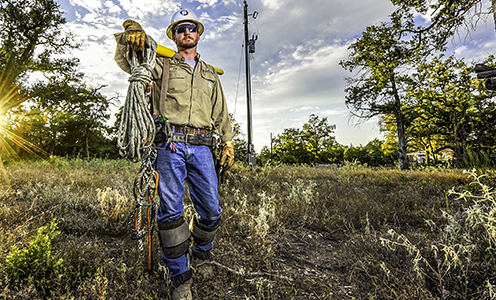
Electric cooperatives across America will observe April 14 as National Lineworker Appreciation Day. Take time to recognize the hard work and dedication of Bluebonnet Electric Cooperative's lineworkers by visiting our social media pages on that day to see a special video tribute to our lineworkers. Not only are they on call to work — any time, any day of the year — to restore electricity during outages, but they install, repair, replace and maintain the cooperative's electrical equipment.
Spring officially begins March 20, bringing new opportunities to save electricity and money. Here are some ways to get started on spring energy savings.
CLEAR THE AIR
Open windows to let fresh air circulate.
COOK OUTSIDE
Soak in the sunshine by grilling or smoking meals. Or toss a salad and make sandwiches to enjoy outdoors.
SEARCH AND SEAL
Cracks and gaps let conditioned air escape. Caulk and weather strip to seal leaks, especially around windows and doors.
LET THE LIGHT IN
Open blinds and curtains and turn off lights to save electricity.
BE FAN FRIENDLY
Set ceiling fans to turn counterclockwise for cooling. Remember, fans cool people, not rooms, so turn them off when you leave.
ADJUST THE THERMOSTAT
Set your thermostat for the milder months ahead. Consider turning it off entirely during mild weather or scheduling cooling before you arrive home if you have a smart thermostat.
TUNE UP YOUR SYSTEM
Have an HVAC technician inspect your system before the peak cooling season.
UNPLUG AND SAVE
Disconnect devices you don’t use regularly. Plugged-in devices draw power even when not in use. A smart power strip makes it easy to turn off multiple items at once.
MOVE OUTDOORS
Trade lights, TVs, computers and devices for outside activities.
Download this story as it appeared in Texas Co-op Power magazine